2026.
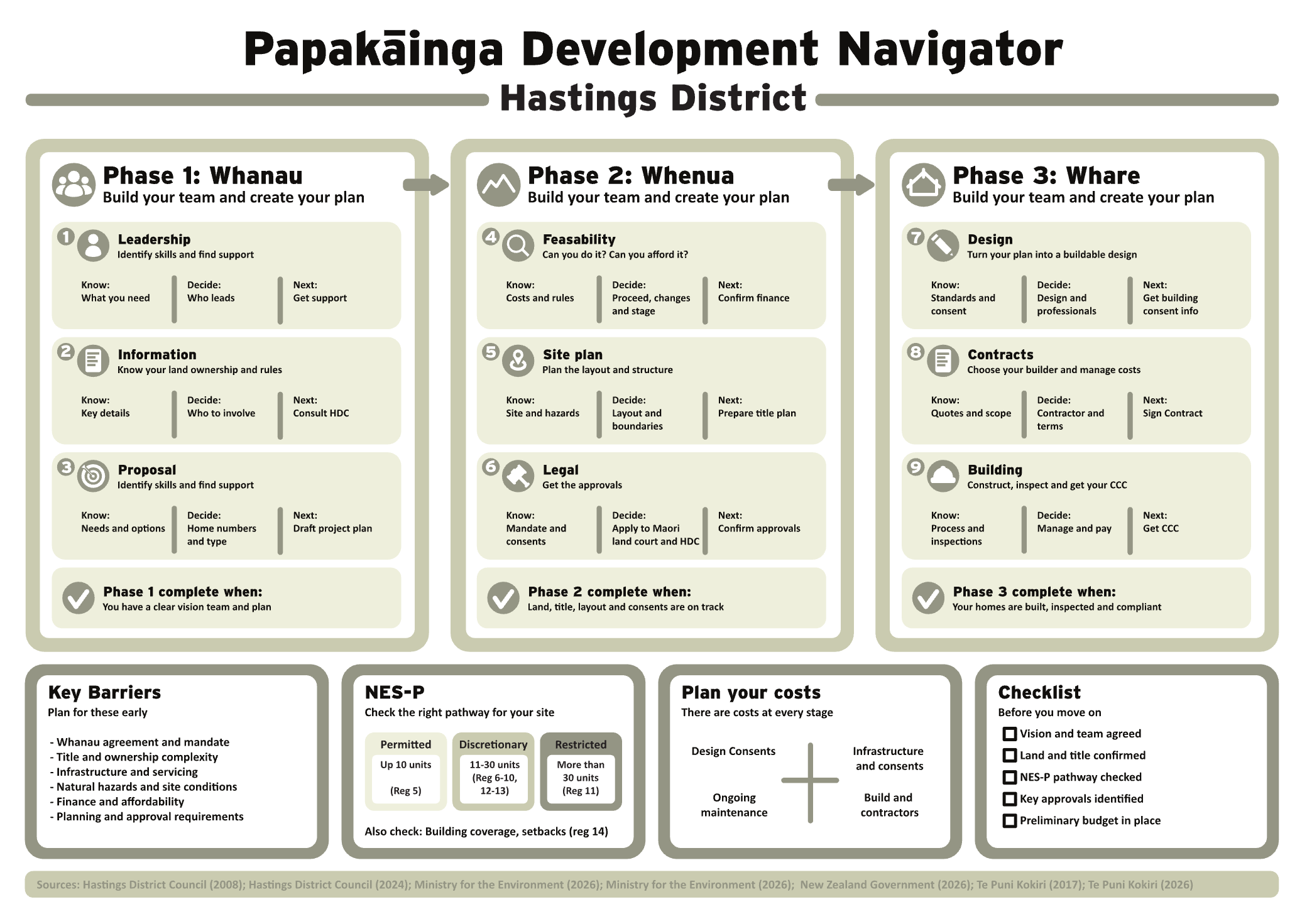
Papakāinga Development Navigator for the Hastings District

1. Leadership

Who will lead the project, make decisions and keep the whānau informed?

General key info

What the whānau needs to know

  • Papakāinga is a long-term whānau project involving land, planning, finance, design and construction—not just building houses. (What is papakāinga)
  • A project leader or Kaiwhakahaere Kaupapa can coordinate the process, but specialist advice may still be needed. (What’s your role)
  • The NES-P may reduce planning barriers, but it does not automatically resolve title, funding or infrastructure problems. (What’s NES-P)
Relevant NES-P rules and HDC rules

Admin and org

Decisions and options

  • Identify existing skills: who has experience in budgeting, governance, construction, design, legal matters or community engagement?
  • Appoint a project leader: an existing whānau member may take this role if they have time and suitable skills.
  • Find external mentors: use a papakāinga adviser, architect, planner, lawyer or project manager when specialist knowledge is needed.

(p. XX)

Barriers and planning implications

  • Whānau capacity: members may have limited time, competing responsibilities or different expectations.
  • Specialist costs: paid advice can add to early costs before the project has secured funding.
  • Hard-to-solve barrier: disagreement about the project’s purpose or leadership can delay every later decision.

Resource allocations

Time, money and support

  • Time: allow time for whānau discussions, role allocation and agreement; the length depends on whānau availability.
  • Money: internal leadership may have little direct cost, but external mentoring or professional advice may incur fees.
  • Who can help: whānau leaders, trusted mentors, relevant Māori organisations and professional advisers.

Move on when

The whānau has agreed on who is leading the project, how decisions will be made and where support is needed.

2. Information (Land and compliance)

What land do we have, who has authority over it, and what constraints might affect development?

General information

What the whānau needs to know

  • Whakapapa, whānau aspirations, ownership and the legal status of the whenua.
  • The current title, owners, trustees, incorporations, restrictions and any existing occupation or use arrangements.
  • The site’s zoning, overlays, hazards, access, nearby activities and existing infrastructure.
  • Potential water supply, wastewater, stormwater, electricity and road-access requirements.

Relevant NES-P rules and HDC rules

Rules checklist

NES-P and HDC checks

  • Locate the property in the Hastings District Plan ePlan. Check zoning, overlays, hazards and applicable rules. HDC’s ePlan can display property-specific district-plan information, including relevant features and rules. (Relevant rules)
  • Ask HDC’s duty planner to help identify the likely planning pathway for the proposed development. (Relevant rules)
  • Check whether the land and proposal meet the NES-P definition and eligibility requirements. (Relevant rules)
  • Identify the regional plan and other requirements that may apply independently of the NES-P. (Relevant rules)
Relevant NES-P rules and HDC rules

To do

Decisions and options

  • Title and ownership: obtain title and ownership information, then ask the Māori Land Court or a suitably qualified adviser whether changes or formal decisions are required.
  • Site information: begin with available council and title records; commission specialist investigations if significant unknowns remain.
  • Council engagement: seek early planning guidance before paying for detailed designs.

Barriers and financial implications

  • Incomplete or complex title arrangements can delay decisions and require legal work.
  • Hazards, poor access or insufficient servicing can limit where homes can be located.
  • A site may appear suitable but require costly investigations or infrastructure upgrades.

Time and money

Basic record checks and an initial council discussion may be relatively low-cost. At the same time, surveys, engineering investigations and legal advice may incur significant fees. Ask providers for estimates before commissioning work.

Relevant NES-P rules and HDC rules

Move on when

The whānau has a reliable picture of the land, ownership, site constraints and likely planning pathway.

3. Proposal (final step of Phase one)

What does the whānau actually want to build, and what is the project trying to achieve?

What the whānau needs to know

  • The vision should reflect the whānau’s housing needs, cultural aspirations, ability to finance development and plans for future generations.

Decisions and options

  • Agree on the purpose of the development and the people it will serve.
  • Estimate how many homes are needed, what types are suitable and whether shared facilities are important.
  • Decide whether the project should be delivered all at once or in stages.
  • Prepare an initial project plan with responsibilities, milestones, key risks and an early budget.

Integrate the NES-P

  • Up to 10 units: investigate the Regulation 5 permitted pathway, including the relevant standards and eligibility requirements.
  • 11–30 units: investigate which restricted-discretionary route applies under Regulations 7–10, or whether another activity pathway applies.
  • More than 30 units: consider the Regulation 11 discretionary pathway.
  • Ancillary activities: identify whether proposed commercial, visitor accommodation, health, education or cultural activities meet the applicable NES-P conditions.
Relevant NES-P rules and HDC rules

Important notes and barriers

Important

Do not select the number of homes on planning status alone. Compare it with the whānau’s needs, site capacity, servicing and realistic financing.

Barriers

  • Option A – smaller initial development: may reduce initial construction and infrastructure demands, but could require a later stage.
  • Option B – larger development: may meet more whānau needs, but may require consent, more professional work and greater upfront capital.
  • Option C – staged development: spreads costs over time, but requires a workable plan for infrastructure, access and later stages.

Move on when

Full phase complete. The whānau has a shared proposal, an initial unit count, a preferred staging approach and a preliminary budget that includes known unknowns.

Move on to phase 2